Burano lies in the northern lagoon, about 7 km from Venice, and is home to around 2,800 people. A wooden footbridge links it to Mazzorbo, an island of gardens and vines that most visitors pass straight through.
Houses in every colour
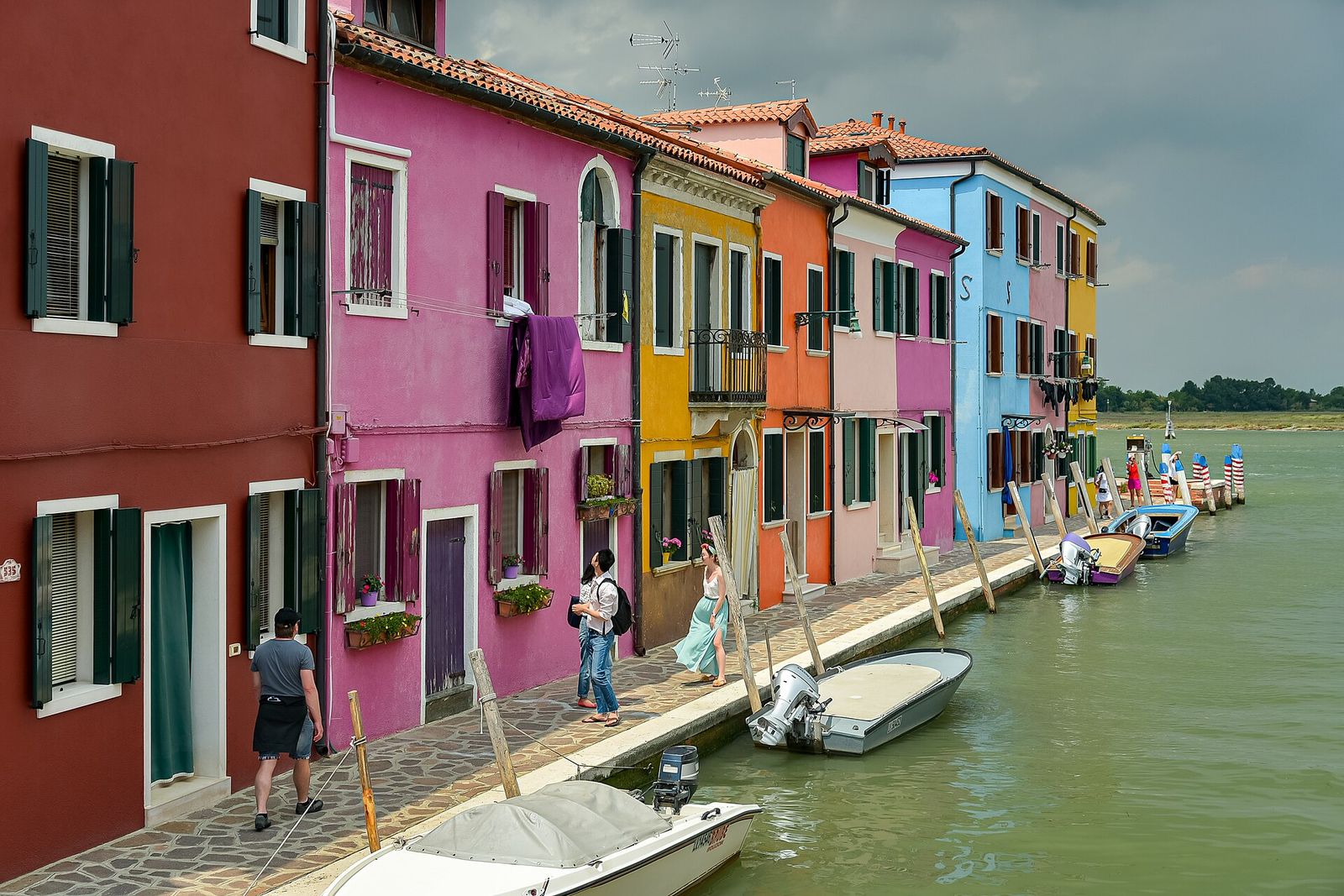
Burano’s houses are small, mostly two or three storeys high, and painted in colours that would look reckless anywhere else: brick red, rose pink, sunflower yellow, orange, deep blue. Seen together along a canal, with washing strung between the windows and boats moored below, they make the island recognisable at a glance.
A popular story says that fishermen painted their homes brightly so they could pick them out from the lagoon on foggy days. It is a good story, and nobody can prove it. What is certain is that the colours are not left to chance. They follow a scheme that goes back to the island’s past, and an owner who wants to repaint must apply to the municipality, which indicates the colours allowed for that building.
The result is a palette that changes from house to house but holds together as a whole. Look at the window frames and shutters too, often painted in a contrasting tone.
Needle lace
Lace has been made on Burano since the sixteenth century. Burano lace is needle lace, built up stitch by stitch with a needle and thread, without the bobbins used in many other lace traditions. A single piece could occupy several women for weeks or months, each traditionally specialising in particular stitches.
The craft declined in the eighteenth century and nearly vanished. In 1872, to bring work back to an island hit by poverty, Countess Andriana Marcello and the politician Paolo Fambri founded a lace school in the old palace of the podestà on the main square. The techniques were passed on by Vincenza Memo, known as Cencia Scarpariola, remembered as the last woman who still knew them all. Within a few years the school had more than a hundred pupils.
The school closed in 1970. Its building now houses the Museo del Merletto, the Lace Museum, opened in 1981 and one of the city’s civic museums. It shows Venetian lace from the sixteenth to the twentieth century, and you may find lacemakers at work in its rooms.
The lace offered around the island ranges from patient handwork to machine-made imports. Ask what you are looking at: a piece of real needle lace takes a very long time to make, and its maker will be glad to explain how.
San Martino and its leaning tower
The parish church of San Martino stands on Piazza Baldassare Galuppi, Burano’s only square, named after the composer who was born on the island in 1706. Inside hangs a Crucifixion painted by Giambattista Tiepolo in the 1720s.
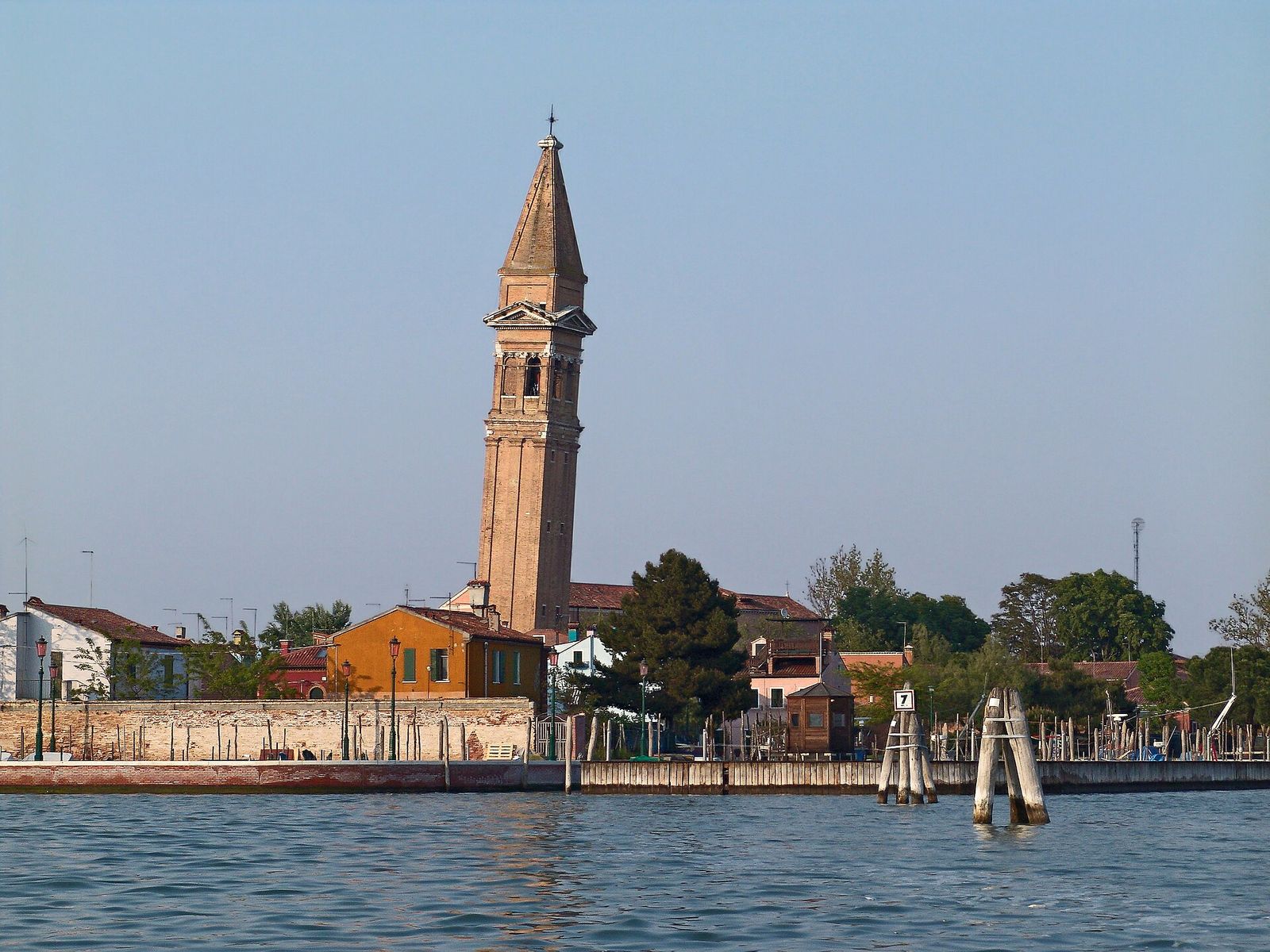
The brick bell tower, around 53 metres tall, leans visibly, by roughly 1.8 metres according to most accounts, because the ground beneath it has settled unevenly. It is best seen from a distance, from the deck as you arrive or from the island’s edges, where its tilt stands out against the straight lines of the houses.
Fishing and the island kitchen
Burano has always lived from the lagoon. Its fishermen worked the channels and shallows around the island, and its cooking still follows what the water provides. Small boats are moored along every canal, with nets and traps stowed on deck or beside the doors.
The dish most closely tied to the island is risotto di gò, made with a broth of goby, a small lagoon fish that is more bone than flesh and full of flavour. In spring and autumn, look out for moeche, small shore crabs caught just as they shed their shells and fried whole. The island’s sweets are the bussolà, ring-shaped butter biscuits, and the S-shaped esse, both dry enough to keep well.
We do not recommend individual places to eat. Menus follow the season and the catch, and asking what came in that morning is a better guide than any photograph on a board outside.
Photographing with care
Burano is one of the most photographed places in the lagoon, and its residents live with that every day. A little care helps keep it a place people want to go on living in.
- People live behind those coloursDo not step into doorways, sit on doorsteps or lean on window sills for a picture, and never photograph into homes through open windows or doors.
- Keep the fondamenta clearThe canal sides are narrow, and they are also the residents’ way home with shopping, prams and trolleys. Step aside rather than blocking them for a shot.
- Ask before photographing peopleEspecially lacemakers at work, children and older residents. A gesture and a smile are usually enough; a shake of the head means no.
- Choose the quieter hoursEarly morning and late afternoon bring softer light and fewer people, and the colours look richer without the harsh midday sun.
- Leave the drone in its caseDrone flights are regulated, and the island is a residential area. Check the official rules before even thinking about it.
Across the bridge to Mazzorbo
A wooden footbridge about 60 metres long crosses the canal between Burano and Mazzorbo. Two minutes’ walk changes the mood completely: the crowds thin out, the houses give way to kitchen gardens, orchards and reed beds, and the loudest sound may be an outboard motor on the canal.
Mazzorbo was once far more important than it looks. Between the ninth and the fourteenth centuries the settlements of this part of the lagoon lived on maritime trade, and Mazzorbo alone had five monasteries and five parish churches. As Venice grew, they declined and emptied. Only Santa Caterina survives, rebuilt in the late thirteenth century; its fourteenth-century bell tower holds the oldest bell in the lagoon, dated 1318.
Near the bridge, a walled vineyard belongs to an old estate bought by the city in 1999 and restored in the following years. Among its vines is Dorona, an old lagoon grape that had almost disappeared. Elsewhere on the island, the brightly coloured housing designed by the architect Giancarlo De Carlo from the late 1970s borrows Burano’s palette in a modern form; it was built to bring residents back to the island.
Mazzorbo has its own water-bus stop, so you can arrive here and walk into Burano over the bridge, or end the day on its quiet fondamenta while you wait for the boat back.
Pairing with Torcello
Torcello lies just north of Burano, and a shuttle boat crosses in about five minutes. Together they make the natural core of a day in the northern lagoon: Burano for colour, lace and lunch, Torcello for its cathedral, its mosaics and its emptiness. Murano fits in on the way out, since the boats from Fondamente Nove to Burano call there.
See the Torcello chapter for what to see there, and the islands page for a complete day plan of the northern lagoon.
How to get there
Burano and Mazzorbo are served by water buses from Fondamente Nove, on the northern edge of the city. Journey times below are typical and depend on the line and the time of day.
Route card
Fondamente NovetoBurano
Tip
Sit outside if you can: the route runs past Murano and across the open northern lagoon, marked by lines of bricole.
Route card
Fondamente NovetoMazzorbo
Tip
Get off one stop early and walk over the wooden bridge into Burano.
Route card
BuranotoTorcello
Tip
Check the time of the last boat back from Torcello before you leave Burano.
Lines, routes and timetables change with the seasons. Check the public transport operator’s official information before you travel; the getting-around chapter explains how stops and lines work.
Questions
How long should I spend on Burano?
Two or three hours are enough to walk the canals, see San Martino and the Lace Museum, and cross to Mazzorbo. Add Torcello and Murano and you have a full day.
Is all the lace on Burano made on the island?
No. Some of it is handmade locally, much of it is not. Ask how and where a piece was made, and visit the Lace Museum first to see what real needle lace looks like.
Can I walk from Burano to Torcello?
No. Torcello is separated from Burano by a channel and there is no bridge. The shuttle boat takes about five minutes.