Few European cities grew up like this. The story runs from a scatter of marsh settlements to a maritime republic that lasted around a thousand years, and on to a modern city negotiating with a rising sea. The timelines pick out the turning points; the text explains why water sits at the centre of each.
Refuge in the marshes (5th–9th centuries)
The lagoon was not empty before Venice. Fishermen and salt-makers worked its islands in Roman times, and the mainland towns of Altinum, Padua and Aquileia used its channels. What changed in the fifth and sixth centuries was the arrival of refugees. As Huns, Goths and then Lombards swept across northern Italy, people from the mainland moved onto the islands, where shallow water and shifting channels kept armies and cavalry at bay.
-
421
A legendary founding
Venetian tradition places the birth of the city at noon on 25 March 421, with the consecration of a church at the Rialto. The date belongs to legend rather than record, but the city still marks it every year.
-
452
Attila sacks Altinum
The destruction of the Roman town on the northern shore of the lagoon drives its people towards the islands.
-
568
The Lombards arrive
A new invasion of the mainland triggers a larger and lasting move into the lagoon.
-
639
A cathedral on Torcello
Santa Maria Assunta is founded on Torcello, then one of the busiest settlements in the lagoon.
-
697
The first doge, by tradition
Chronicles name Paolo Lucio Anafesto as the first doge; historians regard Orso Ipato, elected in the eighth century, as the first securely documented one.
-
810
The move to the Rialto
A Frankish army under Pepin, son of Charlemagne, fails to conquer the lagoon. The seat of government then moves from Malamocco to the Rialto islands, the core of the present city.
The choice of the Rialto, deep in the lagoon and well away from the open sea, set the pattern for the next thousand years. Torcello, once the richer place, slowly declined as its channels silted up and malaria spread; today only a handful of people live there.
A saint, a fleet and the sea (9th–13th centuries)
A city with ambitions needed a patron to match. In 828 two Venetian merchants carried the body of St Mark the Evangelist out of Alexandria, hidden, the story goes, under a load of pork that the customs officers would not touch. The doge built a chapel for the relics beside his palace, and the winged lion of St Mark became the emblem of the state.
-
828
St Mark comes to Venice
The relics arrive from Alexandria, and the first church of San Marco is built to house them.
-
c. 1000
Ascension Day and the Adriatic
Doge Pietro II Orseolo sails on an expedition to Dalmatia that secures Venetian power along the Adriatic coast. The feast of the Ascension, the Sensa, becomes the Republic’s great day on the water.
-
1104
The Arsenale
The traditional founding date of the state shipyard, which grew over the following centuries into one of the largest industrial sites of pre-modern Europe.
-
1177
The Peace of Venice
Pope Alexander III and Emperor Frederick Barbarossa are reconciled in Venice. Tradition links the pope to the gift of the ring used in the marriage with the sea.
-
1204
The Fourth Crusade
Venetian ships carry the crusaders to Constantinople, which is sacked. Venice gains territory across the eastern Mediterranean and brings home the bronze horses of St Mark’s.
At its height the Arsenale could fit out galleys at remarkable speed, from standard parts and in a sequence of workshops that has been compared to an assembly line. Dante knew it well enough to use its vats of boiling pitch as an image in the Inferno. Its walls and towers still enclose a large part of Castello.
Governing the water (1500–1797)
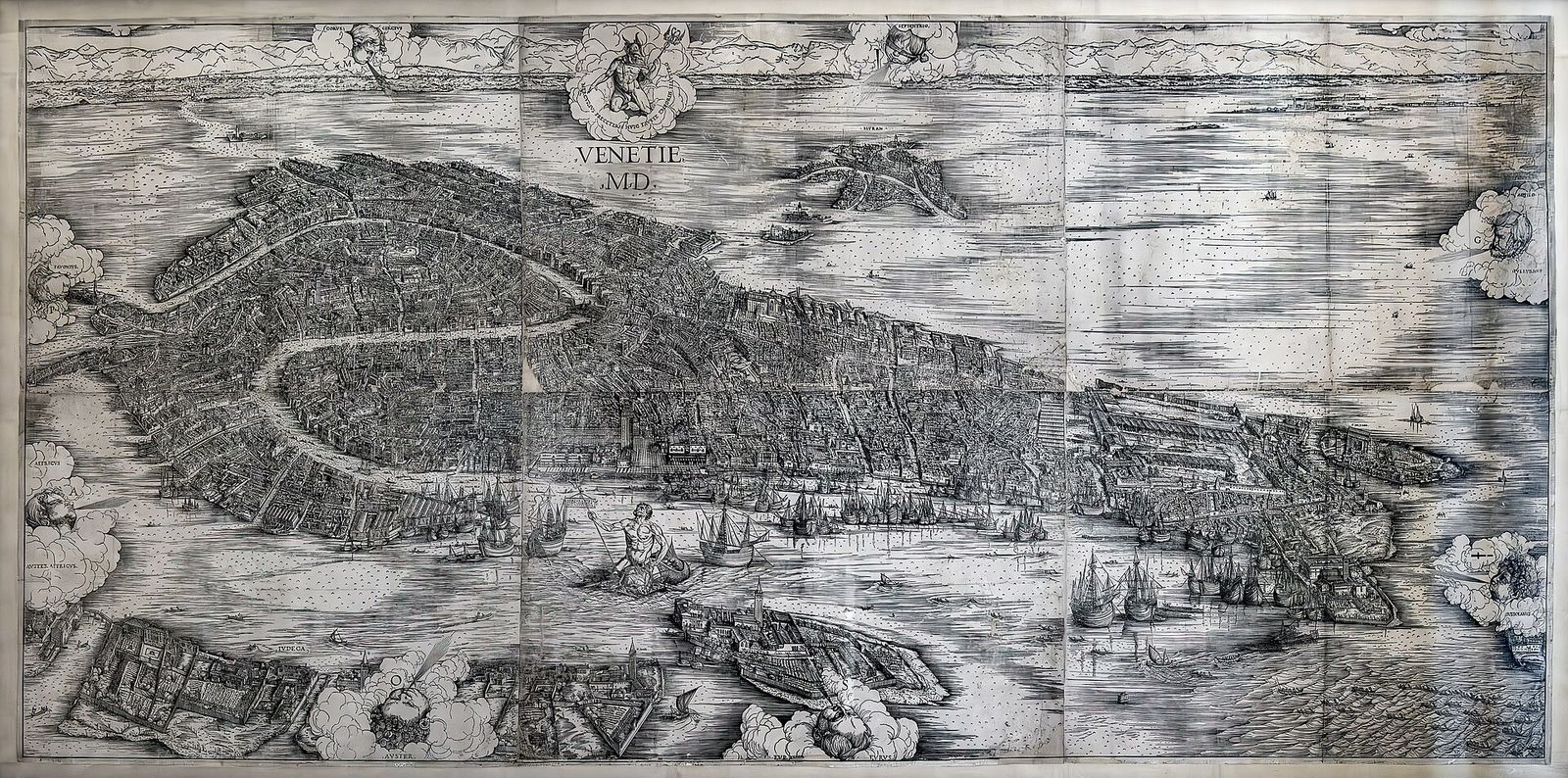
By 1500 the Republic had understood that its greatest danger was not an enemy fleet but its own lagoon. Rivers were filling it with silt from the land side, and storms were eating at the sandbars from the sea. Jacopo de’ Barbari’s great woodcut, published that year, shows a city near the height of its power, surrounded by a lagoon that needed constant care.
-
1501
An office for the waters
The Republic creates a dedicated water office, the forerunner of the Magistrato alle Acque, to oversee rivers, channels and inlets.
-
1500s
Sabbadino’s warning
The engineer Cristoforo Sabbadino argues that river silt is shrinking the lagoon and that the rivers must be led away from it.
-
1610
The Taglio Novissimo
The last of a series of cuts takes the Brenta to the southern edge of the lagoon.
-
1664–83
Piave and Sile
The Piave is diverted east; the Sile is then led out of the northern lagoon into the Piave’s abandoned bed.
-
1744–82
The Murazzi
Massive sea walls of Istrian stone are built along Pellestrina and parts of the Lido, among the last great works of the Republic.
The principle was simple to state and hard to keep: nothing could be done that might harm the lagoon. Digging, filling, building mills or embankments all needed permission, and offenders faced heavy penalties. The chapter on the lagoon and its rivers follows these diversions in detail.
Gondolas, the Bucintoro and the marriage with the sea
For most of its history Venice moved on oars, and the gondola was only one of many local boat types. In the sixteenth century there were thousands of them, many painted and decorated by noble families competing in display. Sumptuary laws meant to curb such extravagance are usually credited with imposing the uniform black that gondolas still wear. The boat itself kept changing: its asymmetrical hull, curved slightly to one side so that a single oarsman standing at the stern can keep it on a straight course, was perfected by boatbuilders in the nineteenth century. Today a few hundred remain, most of them carrying visitors; the gondola ferries that cross the Grand Canal are described in the chapter on getting around by water.
The state had a boat of its own. The Bucintoro was the doge’s ceremonial galley, a floating hall of carved and gilded wood rowed by the men of the Arsenale. Every year on Ascension Day it carried the doge out towards the Lido inlet for the Sposalizio del Mare, the marriage with the sea. After a blessing he dropped a gold ring into the water and spoke a Latin formula claiming the sea for Venice.
Desponsamus te, mare, in signum veri perpetuique dominii.
The last Bucintoro, launched in 1729, did not outlive the Republic. In 1798 French troops stripped it of its gilding and burned the carvings on the island of San Giorgio. Since 1965 the mayor of Venice has re-enacted the marriage with the sea each year at the Festa della Sensa, off the church of San Nicolò on the Lido.
The fall and the causeways (1797–1933)
The Republic did not fall to a siege. In May 1797, with Napoleon’s army on the mainland, the Great Council voted to hand over power, and the last doge, Ludovico Manin, stepped down. Within months the city had been traded away.
-
1797
The end of the Republic
On 12 May the Great Council dissolves the government. In October the Treaty of Campo Formio hands Venice to Austria.
-
1846
A railway across the lagoon
Under Austrian rule a long railway bridge links Venice to the mainland for the first time.
-
1866
Venice joins Italy
After the war of 1866, Venice and the Veneto pass to the Kingdom of Italy, confirmed by a plebiscite.
-
1933
A road to the city
A road bridge opens beside the railway, ending at Piazzale Roma. First named Ponte Littorio, it became the Ponte della Libertà after the Second World War.
The two bridges changed Venice more than any battle. For the first time people could arrive without a boat, and the city’s working life drifted towards the mainland, where the industrial port of Marghera grew through the twentieth century.
The modern lagoon (1966–today)
The flood of 1966 was the moment the modern city realised that the lagoon’s old balance had broken. Everything since, from special laws to mobile gates, has been an attempt to restore it.
-
1966
The great flood
On 4 November the tide reaches about 194 cm, the highest on record, and the sea breaks through the Murazzi at Pellestrina.
-
1973
A special law
The Italian state passes the first special law for Venice, declaring the protection of the city and its lagoon a matter of national interest.
-
1987
World Heritage
UNESCO inscribes “Venice and its Lagoon” on the World Heritage List.
-
2003
Work on MOSE begins
Construction starts on the mobile flood gates at the three inlets.
-
2019
A second great tide
On 12 November the water reaches about 187 cm, the second-highest level ever measured.
-
2020
The gates rise
On 3 October MOSE is raised against a real high tide for the first time.
The water is not the only pressure. The resident population of the historic city is now less than a third of what it was in the early 1950s, and the balance between residents and visitors is as hotly debated as the gates. How the tides and the barriers work today is explained in the chapter on tides, acqua alta and MOSE.
Where to see this history
Much of the story can be traced on foot and by boat in a few days.
- The Museo Correr on St Mark’s Square holds Jacopo de’ Barbari’s view of Venice, together with its original woodblocks, and decorative fragments that survived the burning of the last Bucintoro.
- The Naval History Museum near the Arsenale shows ship models from the Republic, among them a large model of the Bucintoro.
- The land gate of the Arsenale, guarded by stone lions brought back as trophies, can be seen from the canal and the square in front of it; parts of the old shipyard host exhibitions of the Biennale.
- St Mark’s Basilica and the Doge’s Palace show the saint and the state side by side, with mosaics telling the story of the relics.
- On Torcello, the cathedral and the church of Santa Fosca are what remains of the early lagoon’s busiest island.
Places in the story
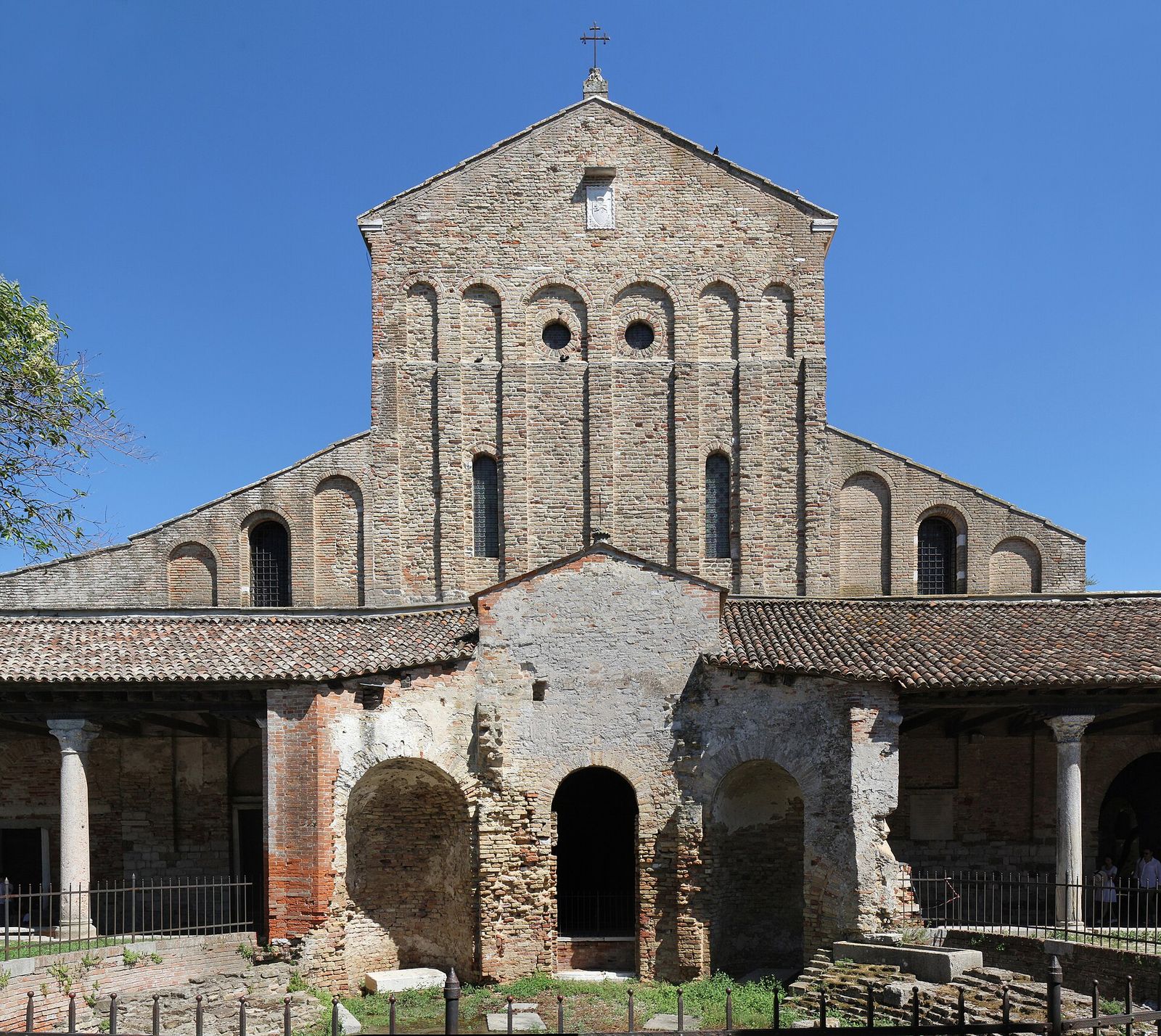
Torcello’s cathedral, founded in 639 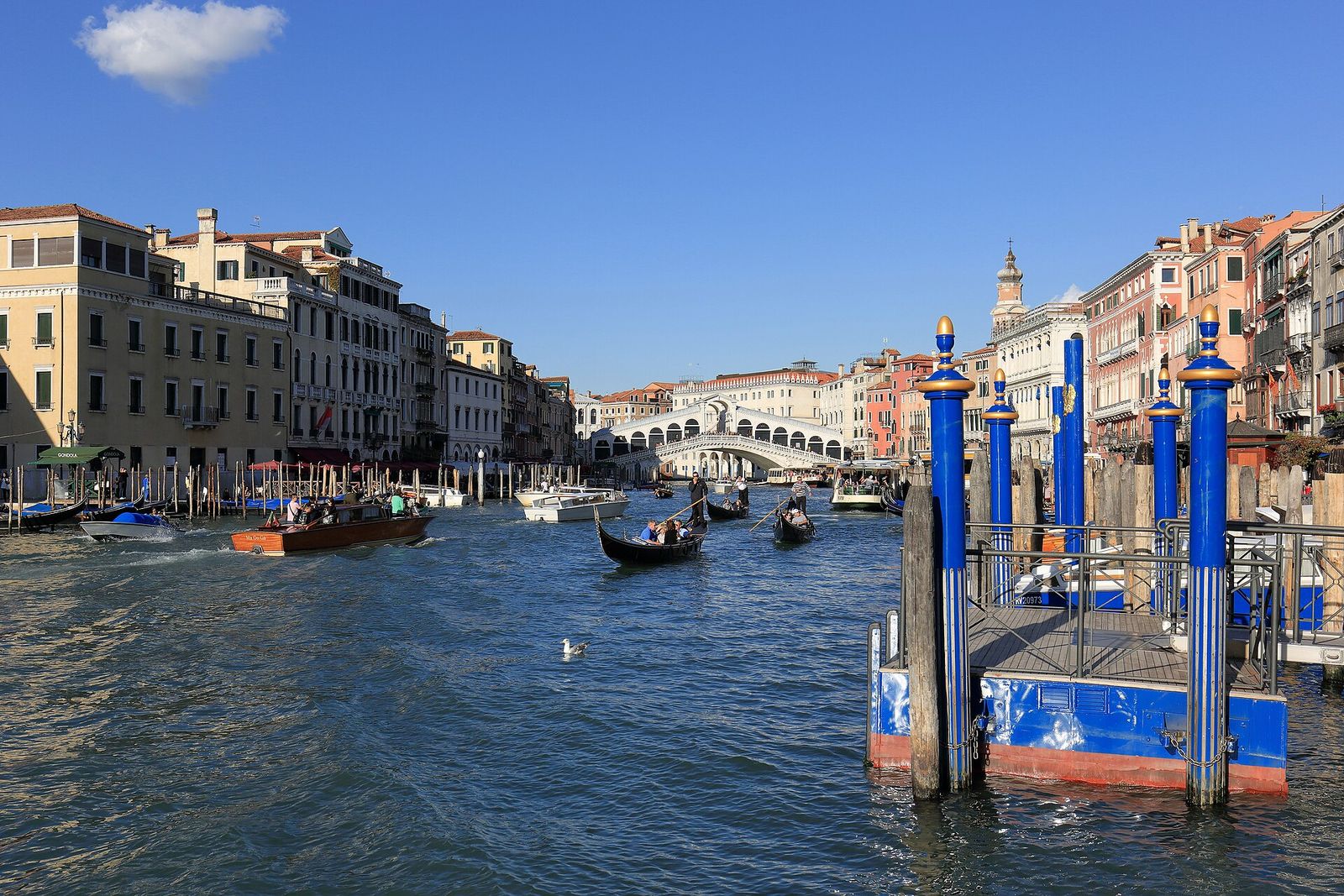
Rialto, the heart of the city since the 800s 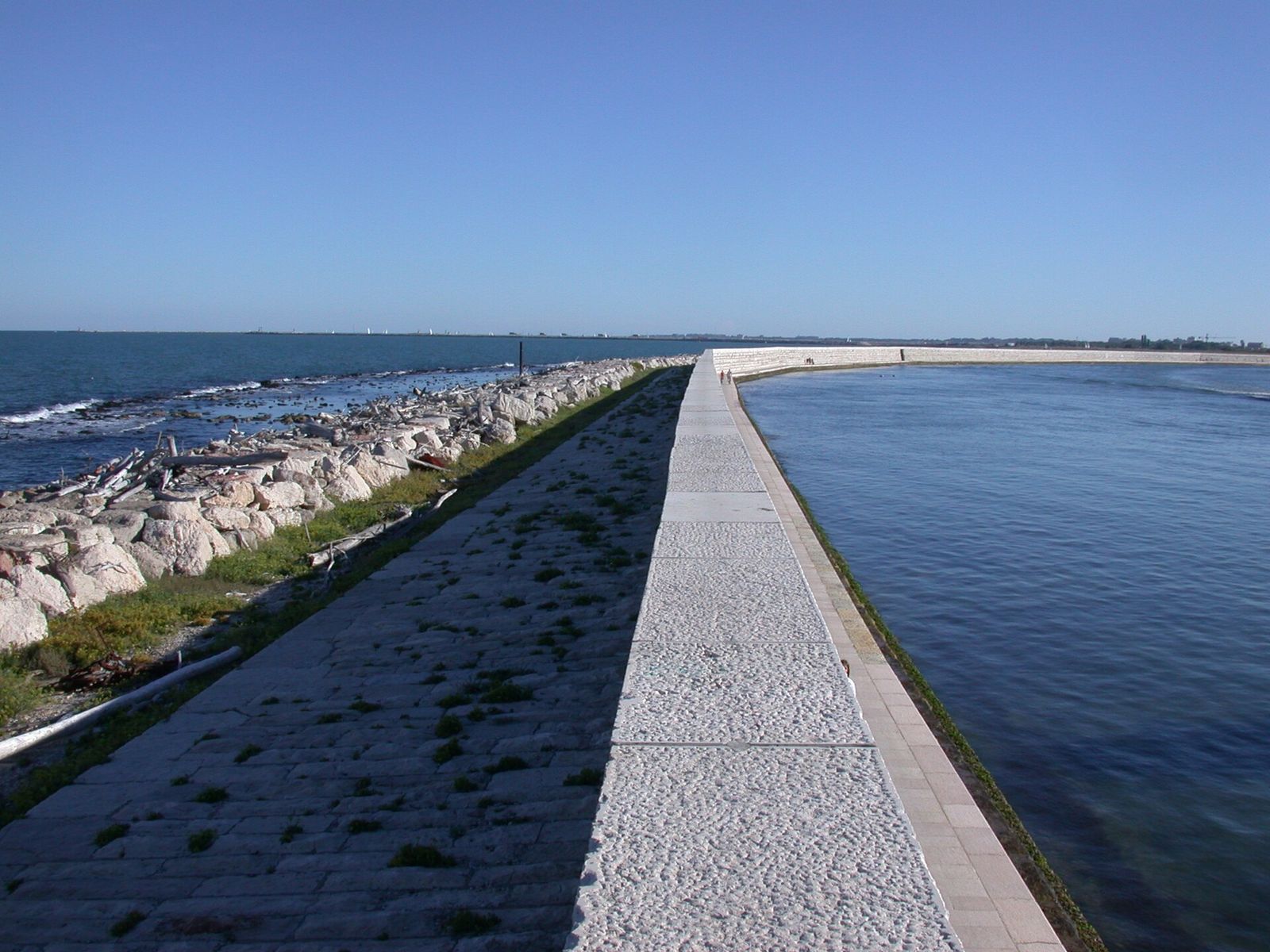
The Murazzi, built 1744–82 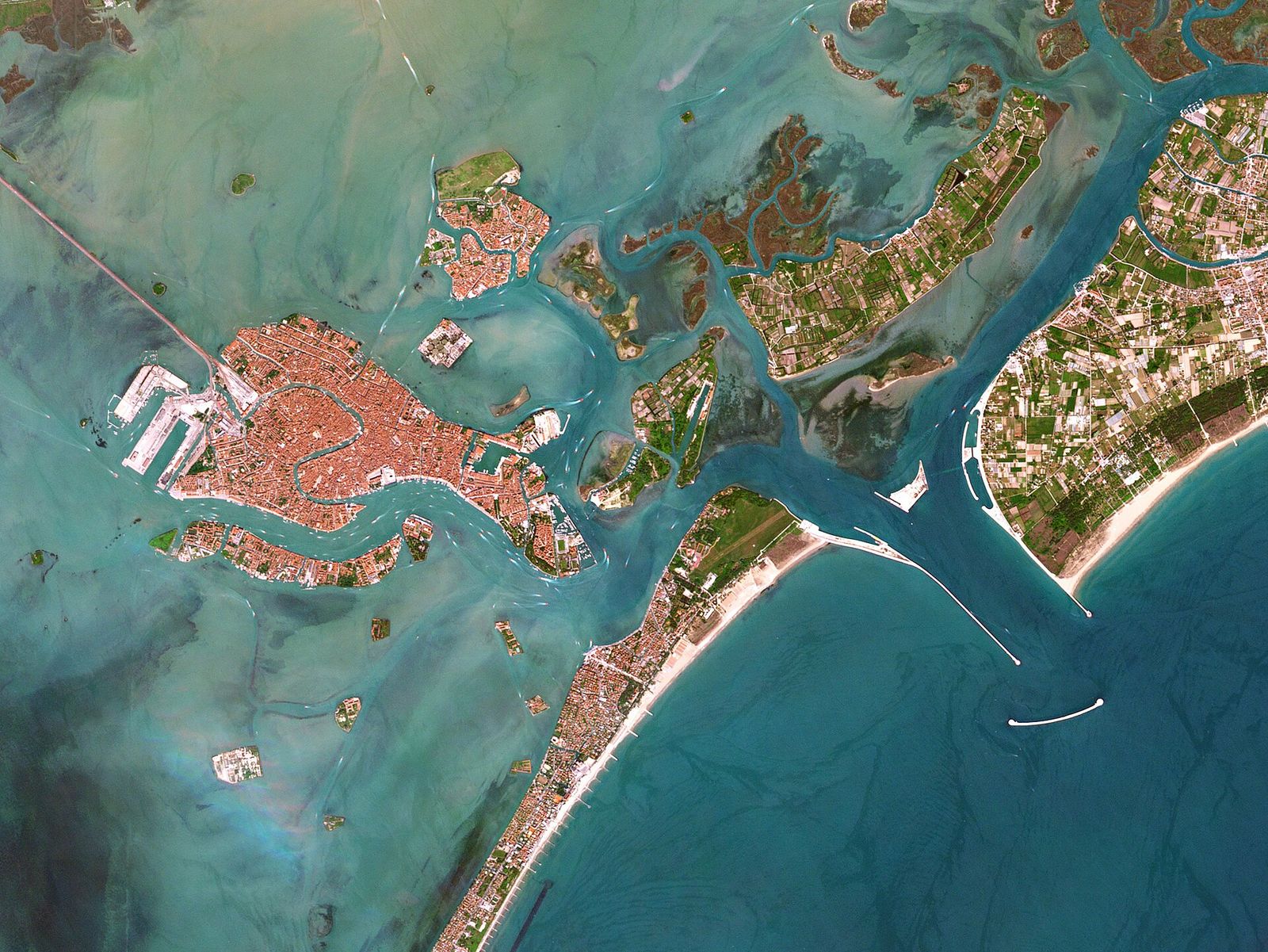
The causeways of 1846 and 1933 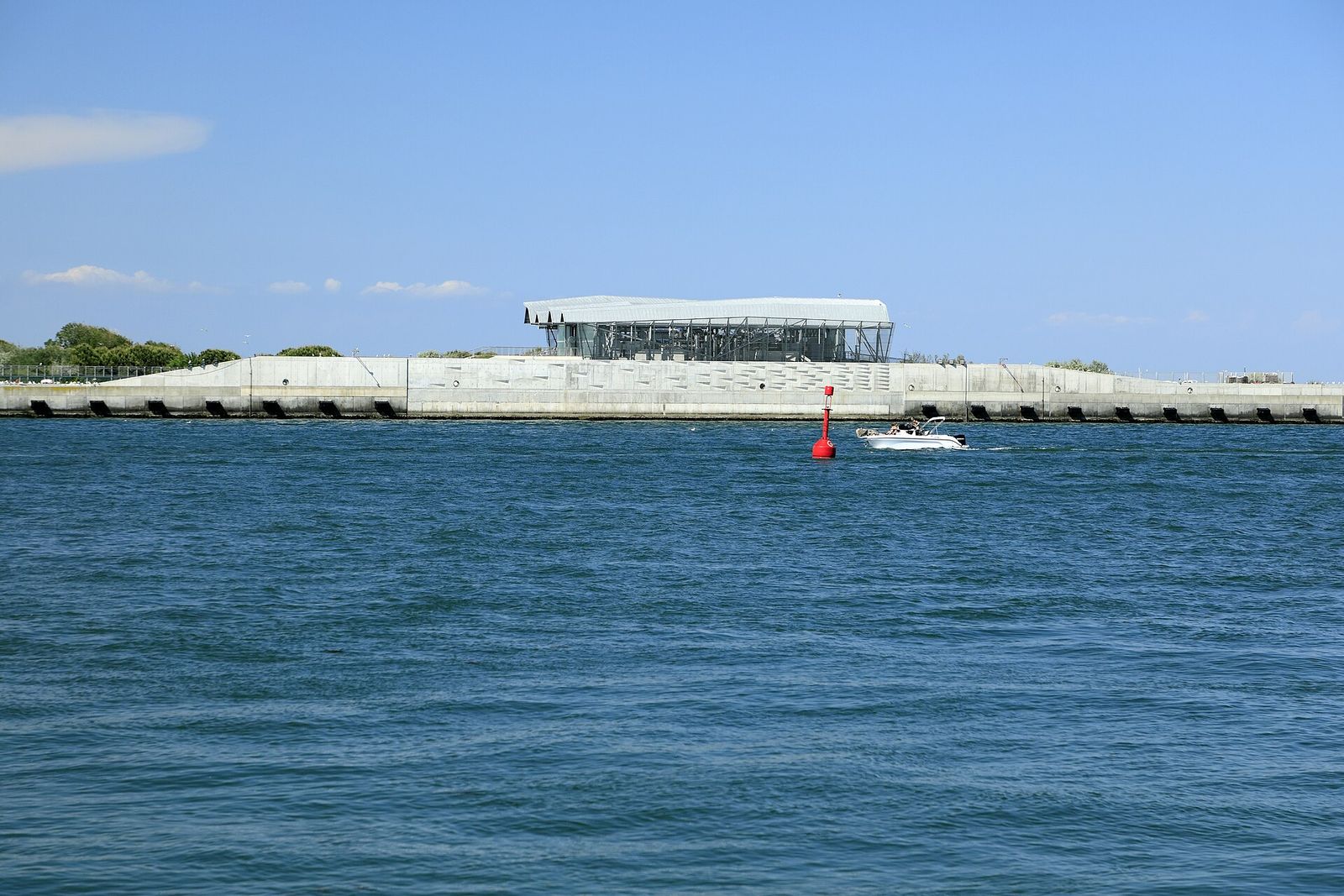
MOSE at the Chioggia inlet