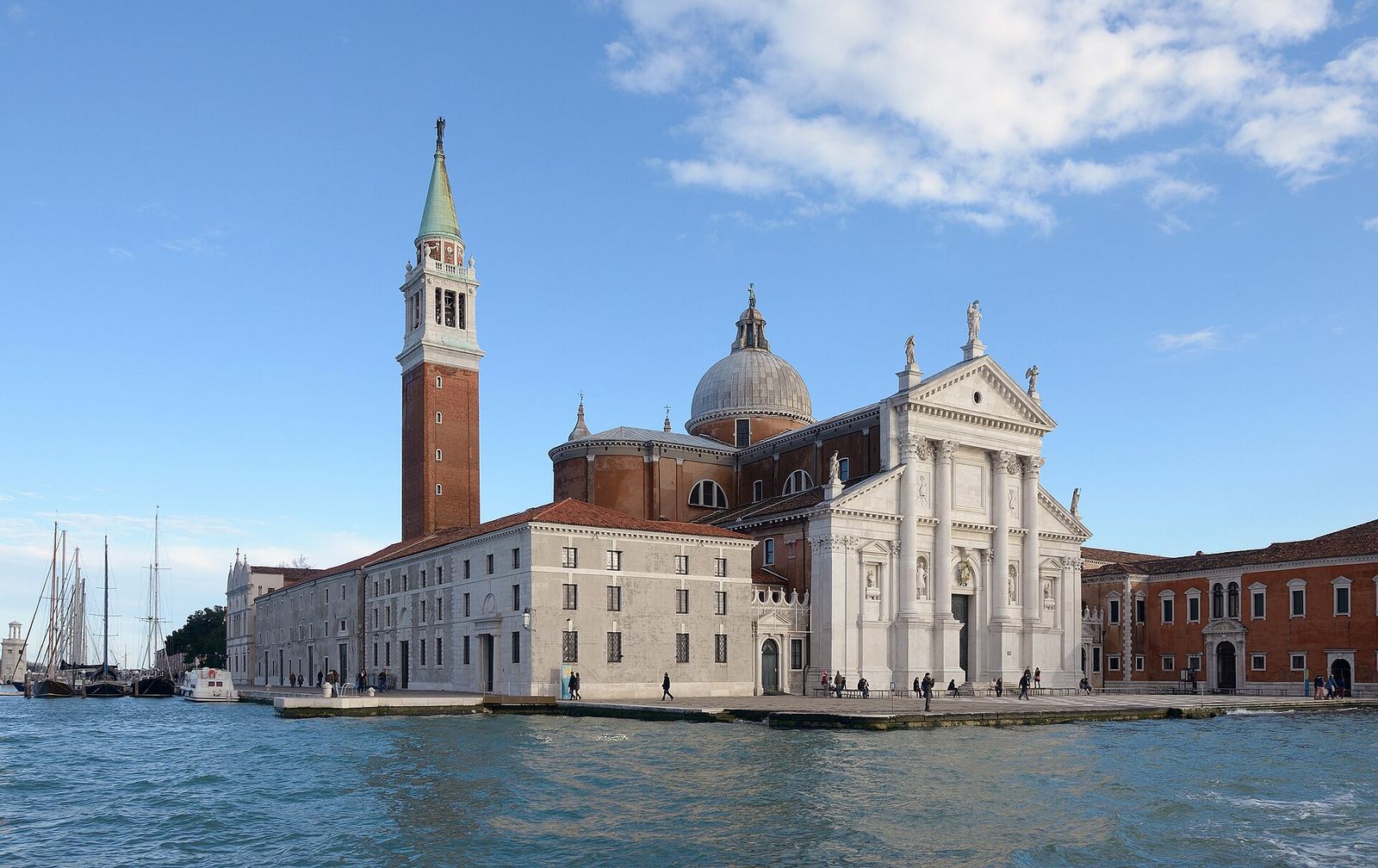
These are the islands you look at from the Riva degli Schiavoni and the Zattere. Each is a short boat ride away and each is anchored by a church by Andrea Palladio; otherwise they could hardly be more different.
Giudecca, the long island
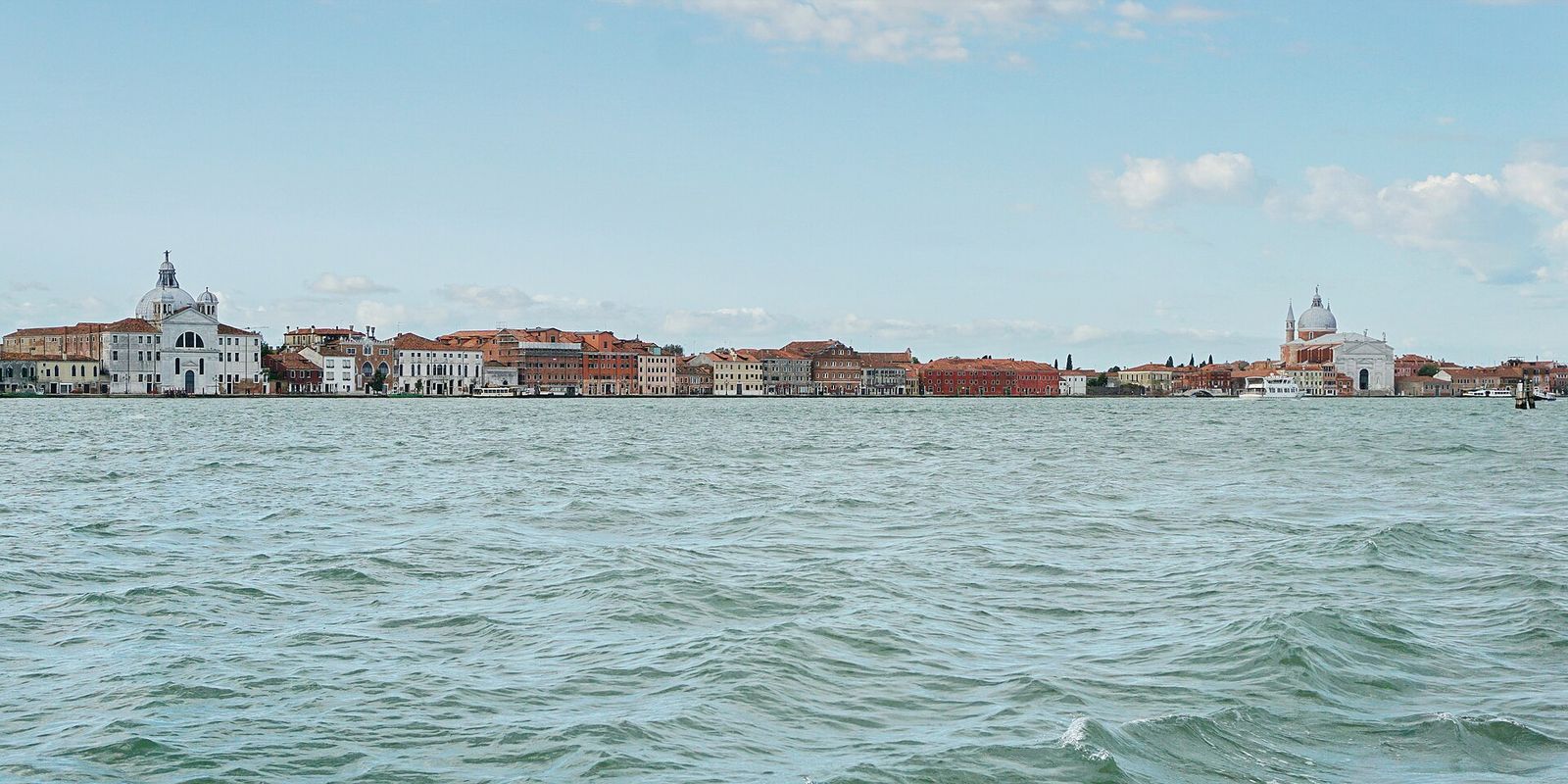
Giudecca curves along the southern edge of the city like a breakwater, separated from Dorsoduro by the Giudecca Canal, a broad, deep channel long used by the largest ships coming into the city. It is made up of eight islets joined by bridges, with a continuous fondamenta along the canal side. In the Middle Ages it was called Spinalonga, a name usually explained by its long, thin shape.
The origin of the present name is uncertain. It may recall a medieval Jewish community, the giudei, or the Venetian zudega, land assigned by a judgement to exiled families allowed to settle here.
Renaissance villas and convents once filled the island; in the nineteenth century came shipyards and factories, drawn by the deep water. Today Giudecca is mainly residential, home to around four thousand people, and noticeably calmer than the centre across the canal.
The Redentore and its festival
In 1575–76 a plague killed around 46,000 people in Venice, between a quarter and a third of the population. The government vowed to build a church to Christ the Redeemer and to visit it in procession every year. Andrea Palladio was chosen as architect, the first stone was laid in May 1577 and the church was consecrated in 1592, twelve years after his death. It was entrusted to the Capuchin friars.
The Redentore is meant to be seen from the water. Its white façade of interlocking temple fronts rises above a broad flight of steps, crowned by the dome and two slender bell turrets. Inside, the single nave is calm and luminous, and the design draws you forward to the high altar, as a procession would move.
The Festa del Redentore
The vow is still kept. For the third weekend of July a temporary bridge on pontoons is laid across the Giudecca Canal from the Zattere to the church, and on the Sunday people walk over it to mass, as the doge and the Senate once did. The Saturday night before is the city’s great summer festival: boats hung with lanterns and laden with food gather in the basin of St Mark’s and the Giudecca Canal, crowds line the waterfronts, and late in the evening fireworks light up the water.
Le Zitelle and the Stucky mill
At the eastern end of the island, facing the basin of St Mark’s, stands the church of Santa Maria della Presentazione, known as Le Zitelle. It was built in the 1580s, after Palladio’s death, to a design attributed to him, as part of a charitable house for poor unmarried girls (zitelle), who were taught crafts such as lace-making.
At the opposite end of the island the skyline belongs to a very different building: the former Molino Stucky, a vast neo-Gothic flour mill in red brick, with pointed towers and gables that look more like northern Europe than Venice. It was built between 1884 and 1895 for the industrialist Giovanni Stucky to designs by the German architect Ernst Wullekopf. Production declined from the 1910s and stopped in 1955; the empty building was badly damaged by fire in 2003 and later restored. Seen from the Zattere at sunset, its mass of brick is one of the surprises of the waterfront.
Everyday Giudecca
The best way to see the island is to walk the fondamenta from Le Zitelle to the old mill, roughly half an hour at an easy pace, then cut inland along the narrow calli between the islets. You pass the Redentore, the church of Sant’Eufemia, with origins in the ninth century, boat repair yards and small squares.
The real reward is the view back across the water to the Zattere, the dome of the Salute and, further east, the Doge’s Palace. For more on the water around you, see canals and rii.
San Giorgio Maggiore
San Giorgio Maggiore closes the view from St Mark’s. A Benedictine monastery was founded here in 982 and became one of the most important religious houses in the lagoon. The church you see today was begun to Palladio’s design in 1566; the façade, with its giant columns on tall pedestals, was completed after his death, in the early seventeenth century, following his model.
The white, light-filled interior is a lesson in proportion rather than decoration. Two late paintings by Jacopo Tintoretto hang in the chancel: a Last Supper, set at a steep diagonal and lit by a smoking lamp whose fumes turn into ghostly angels, and the Gathering of the Manna. Both date from the early 1590s, the painter’s last years.
The view from the bell tower
The campanile, about 75 m tall, was rebuilt in 1791 after its predecessor collapsed in 1774. A lift takes visitors up to the bell chamber, and the view is among the finest in Venice: St Mark’s across the basin, the domes of the Salute, the length of Giudecca, the Lido and, on clear days, the Alps. Because the tower stands apart, you see the city as a whole.
The monastery and the Giorgio Cini Foundation
After the fall of the Republic the monastery was suppressed, and for almost a century and a half the island was used by the military and decayed. In 1951 the industrialist Vittorio Cini set up the Giorgio Cini Foundation, named after his son, who had died in a plane crash, and restored the buildings as a centre for the study of Venetian culture. Parts of the former monastery can be seen on guided visits: two cloisters, one of them by Palladio; Baldassare Longhena’s library and grand staircase; and Palladio’s refectory, where a full-size facsimile of Veronese’s Wedding at Cana has hung since 2007 in place of the original, taken to Paris in 1797 and now in the Louvre.
In the gardens, the Teatro Verde, an open-air theatre designed by Luigi Vietti and opened in 1954, looks out over the lagoon, and a hedge maze created in 2011 in memory of Jorge Luis Borges lies behind one of the cloisters. What can be visited depends on the foundation’s programme, so check its official information.
How to get there
Both islands are on the water-bus lines that cross the basin of St Mark’s and run along the Giudecca Canal. Giudecca has several stops, from east to west Zitelle, Redentore, Palanca and Sacca Fisola; San Giorgio has one. Journey times are typical.
Route card
San ZaccariatoSan Giorgio
Tip
The stop is right in front of the church. Not every boat from San Zaccaria calls here, so read the platform sign.
Route card
ZatteretoGiudecca
Tip
On the weekend of the Festa del Redentore you can also cross on foot by the votive bridge.
Lines and timetables change with the seasons. Check the public transport operator’s official information before you travel, and see Getting Around by Water for how stops and platforms work.
Questions visitors ask
Is there a bridge to Giudecca?
Not a permanent one. The Giudecca Canal is crossed by boat, except on the weekend of the Festa del Redentore in July, when a temporary pontoon bridge links the island to the Zattere.
Can I see both islands in one outing?
Easily. San Giorgio and Zitelle, at the eastern end of Giudecca, are usually a single water-bus stop apart, so the two fit into half a day.
When is the best time of day to visit?
Late afternoon is a good choice: the sun lights the city front across the canal, and the Giudecca fondamenta fills with residents coming home.